Interactive 3D brain atlas for introductory neuroscience, built to support my coursework in the UNO neuroscience program. 47 structures from the BodyParts3D dataset, color-coded by region, with chapter-by-chapter study guides that highlight the specific structures discussed in each chapter of Watson & Breedlove's Behavioral Neuroscience.
Chapter Guides
-
Ch 10: Biological Rhythms and Sleep
Hypothalamus (SCN), pineal gland, brainstem, retinohypothalamic pathway
-
Ch 13: Memory and Learning
Hippocampus, mammillary bodies, thalamus, basal ganglia, cerebellum, LTP
-
Ch 14: Attention and Higher Cognition
Frontoparietal networks, TPJ, prefrontal cortex, executive function, consciousness
-
Ch 15: Language and Lateralization
Broca's area, Wernicke's area, aphasia types, split-brain, dyslexia, FOXP2, recovery
How It Works
3D Meshes
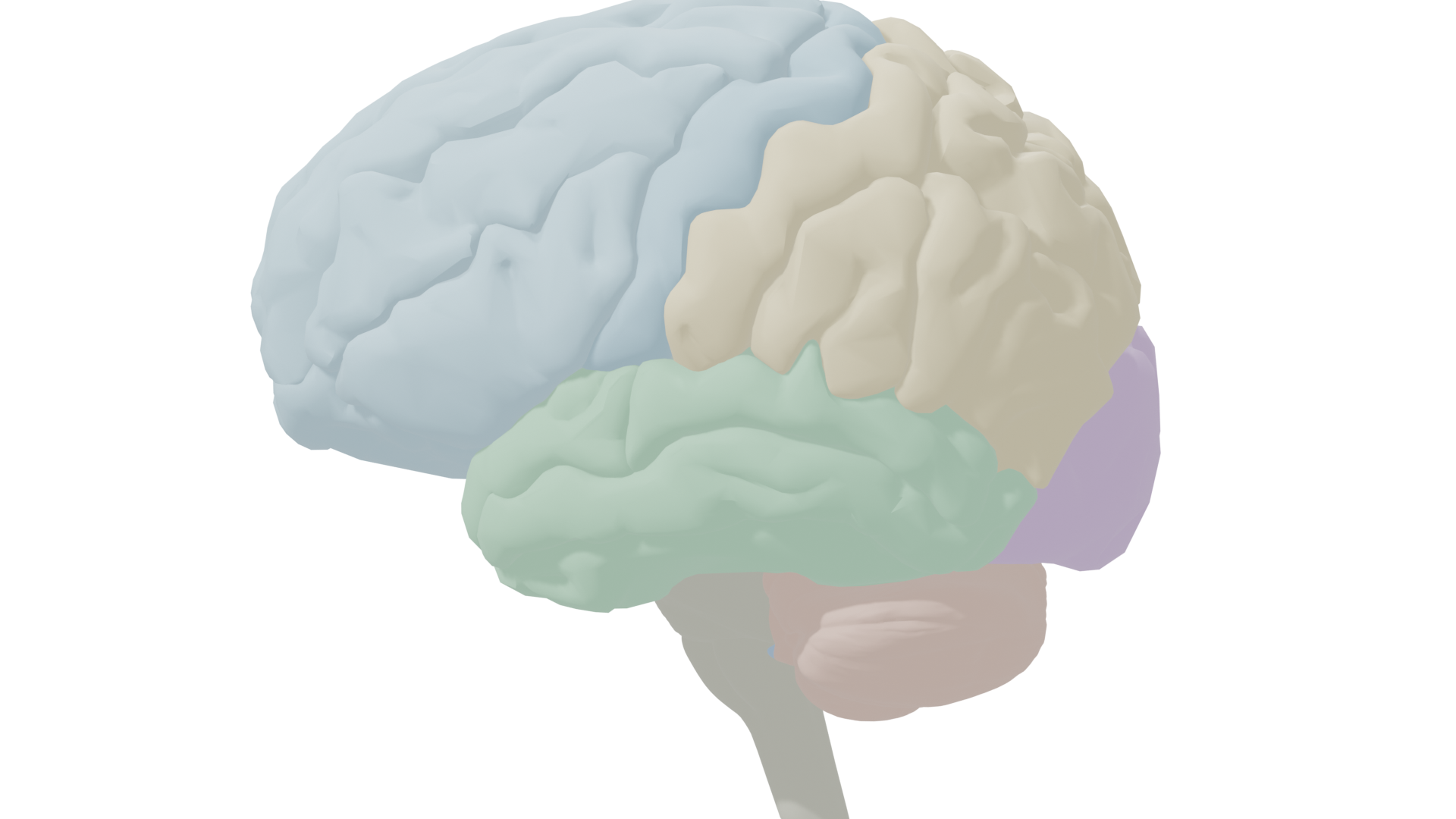
47 brain structures extracted from the BodyParts3D v4.0 dataset (Database Center for Life Science, Japan). Each structure is an OBJ mesh file, imported into Blender and color-coded by anatomical region: frontal (blue), parietal (gold), temporal (green), occipital (purple), limbic (orange), brainstem (olive), cerebellum (terracotta).
Rendering Pipeline
A Python script (render_chapter.py) drives Blender in headless mode. Each chapter config specifies which structures to highlight and which camera views to render. Highlighted structures get full color and emission; everything else is ghosted to near-transparency. Six views per chapter at 1920x1080 with transparent backgrounds.
Study Guides
Each chapter page is a self-contained HTML file with structure cards, pathway diagrams, clinical case studies, comparison tables, and a glossary of key terms. Designed for both desktop and mobile, with light/dark theme support.